
Handstand
Learn the handstand as an adult beginner: shoulder strength, wall walks, a stacked hold against the wall, common faults, and how to come down safely.
What the handstand is
A handstand is a gymnastics position where you balance upside down on your hands with the arms locked overhead and the body stacked in a straight line. In CrossFit it trains shoulder strength, overhead stability, midline control and body awareness. Beginners start with pike holds on a box and wall walks before holding a handstand against the wall.
Why it is in class
Handstands are in CrossFit because they ask the shoulders to support your full body weight overhead while the trunk stays rigid, which builds the same position used in presses, jerks and overhead squats. They also teach you where your body is in space, a skill most adults have not practiced since childhood. Going upside down for the first time in years feels unusual, and getting comfortable there builds real confidence. In daily life, the shoulder stability helps when you lift a heavy box onto a high shelf or hold something overhead for a long stretch, and the body awareness helps you stay balanced and react well if you slip.
Points of performance
What a good rep looks like, from setup to finish.
Hands set like a press
Place the hands about shoulder width apart, fingers spread wide and pointing forward, roughly a hand length from the wall when facing it. Push the floor away hard. Your hands are your feet now, and active fingers are how you make small balance corrections.
Arms locked, shoulders open
Keep the elbows straight and push up through the shoulders so the ears sit between the arms. This is the same finished position as a strict press overhead. Shoulders that collapse let the head sink and put more load on the neck and wrists.
Ribs in, hollow body
Pull the ribs down and squeeze the glutes so the lower back does not arch into a banana shape. Think of one long, tight line from wrists to toes. A hollow, stacked body feels lighter on the hands and is far easier to hold.
Eyes on the hands
Look at the floor between your hands rather than tucking the chin to the chest or cranking the neck back. Your gaze sets the head position, and the head position helps keep the whole body stacked over the hands.
Know your exit
Before you go up, learn how to come down. Facing the wall, you walk the hands out and the feet down. Away from the wall, you step down one leg at a time or turn the hips sideways in a cartwheel exit. Your coach teaches this first.
Common beginner faults, and the fix
Banana back
What it looks likeThe lower back arches deeply and the belly hangs toward the wall, with the legs falling behind.
The fixSqueeze the glutes and pull the ribs in. Walk the hands closer to the wall when facing it so the body can stack straighter.
Bent arms
What it looks likeThe elbows soften and the head sinks toward the floor as the shoulders tire.
The fixPush tall through the shoulders and shorten the hold. Come down while the arms are still straight and build time gradually.
Hands too far from the wall
What it looks likeThe body forms a steep angle against the wall and the shoulders are not stacked over the hands.
The fixOn each wall walk, bring the hands a little closer until the chest is nearly touching the wall.
Panic exit
What it looks likeThe athlete collapses or drops straight down toward the head when tired.
The fixRehearse the exit at the start of every session so stepping or turning out becomes automatic.
Where you start, and where it goes
Every movement in class has a version that fits you today.
Start here
Plank holds and pike holds with the feet on a box and the hips stacked over the shoulders.
Next step when: When you can hold a box pike for around half a minute with straight arms and a neutral head.
Building
Partial wall walks, walking the feet a few steps up the wall and the hands back in, then walking down with control.
Next step when: When you can walk all the way up until your chest is close to the wall and come down smoothly several times.
Full movement
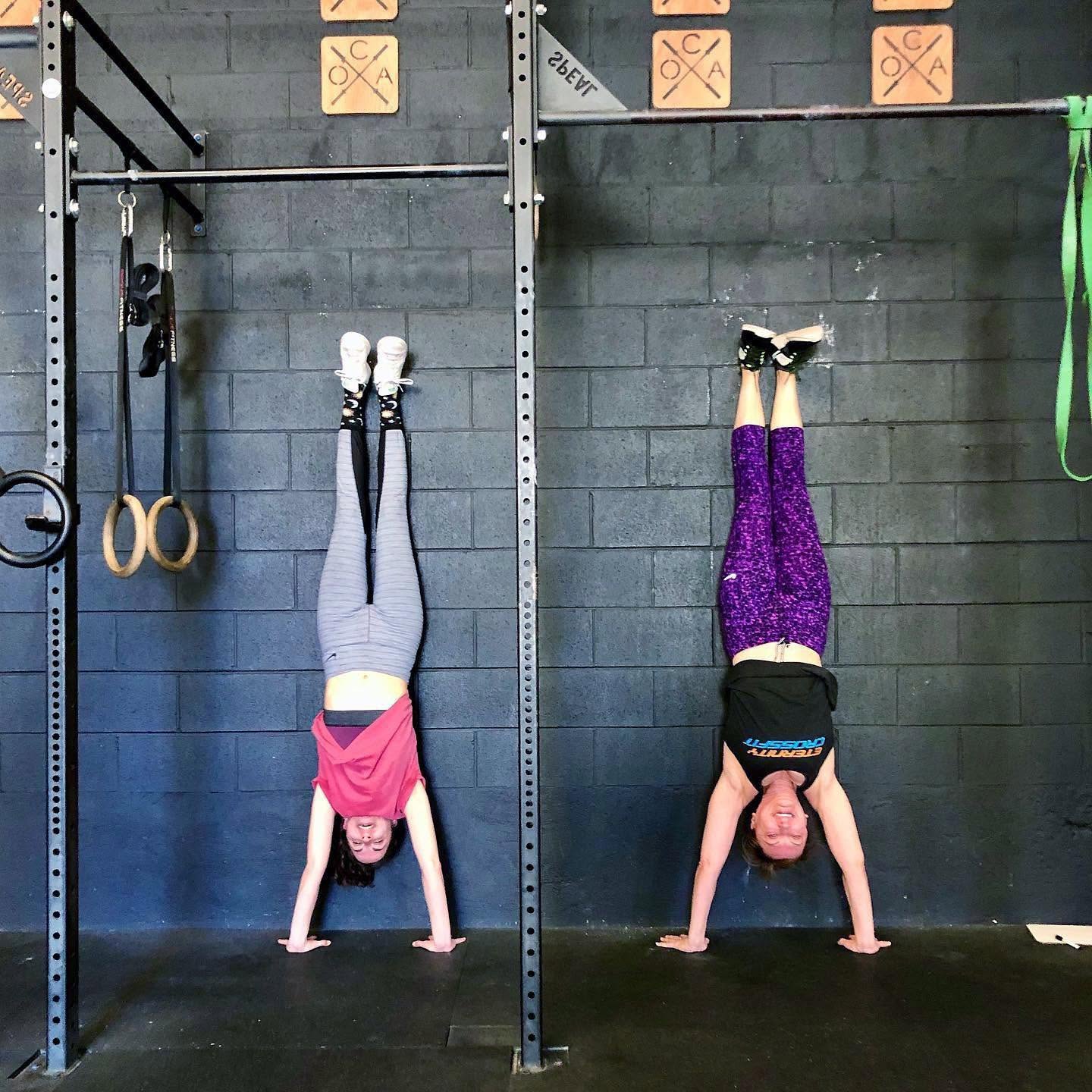
Handstand holds against the wall, chest facing the wall or back to the wall, arms locked and body stacked.
Next step when: When you can hold a stacked wall handstand for around a minute, your coach may introduce handstand push-ups or freestanding work.
Beyond
Freestanding handstand holds, handstand walking, and strict and kipping handstand push-ups.
Next step when: Progress these patiently, and keep strict shoulder strength work and the exit skill in every session.
Handstand in real classes
1 video from the gym floor in San Clemente, shared by our coaches and members.
Learning it in your first classes
Plenty of adults walk in having not been upside down since grade school, and your first classes treat the handstand as a skill built in small steps. Your coach will likely start you with planks and box pike holds, check your shoulder mobility and teach you how to come down before you ever go fully up. They watch whether your arms stay straight, whether your back arches and how calm you stay. Tell the coach about any wrist, shoulder, neck or blood pressure concerns and any history of dizziness, and check with a doctor if you are unsure whether going upside down is right for you.
What your first class at O-SEA CrossFit is like · How On-Ramp teaches the movements
Questions beginners ask
Is it scary to do a handstand as an adult beginner?
Feeling nervous about a handstand is normal, especially if you have not been upside down for decades. That is why coaches build the handstand in steps: box pike holds, partial wall walks, then full wall holds, with the exit taught first. Each step gets you used to the position before you add more height.
Do I need to kick up to do a handstand?
No. Many beginners never kick up at first. Wall walks, where you walk your feet up the wall while your hands walk in, get you into a handstand with more control and less fear of falling. Kicking up into a handstand against the wall is a skill your coach can teach once the wall walk feels comfortable.
Should I face the wall or face away from it?
Both versions of the wall handstand have value. Chest to the wall, usually reached by a wall walk, teaches the best stacked body line. Back to the wall, reached by a kick up, is common for handstand push-ups. Most coaches teach the chest to wall handstand first because it encourages a hollow position.
How strong do my shoulders need to be for a handstand?
You need enough strength to hold your body weight on straight arms, which is exactly what box pike holds and wall walks build. If you can hold a solid plank and a box pike with locked arms, you are ready to start working toward a handstand against the wall with your coach watching.
What if I have high blood pressure or get dizzy upside down?
If you have high blood pressure, glaucoma, a history of dizziness or any condition where being inverted could matter, check with your doctor before practicing a handstand and tell your coach. They can give you upright shoulder work, such as presses and plank holds, that builds similar strength while you get clearance.
Related movements
Learn the handstand with a coach beside you
Every class at O-SEA CrossFit is coached and every movement scales. Your first one is free.