
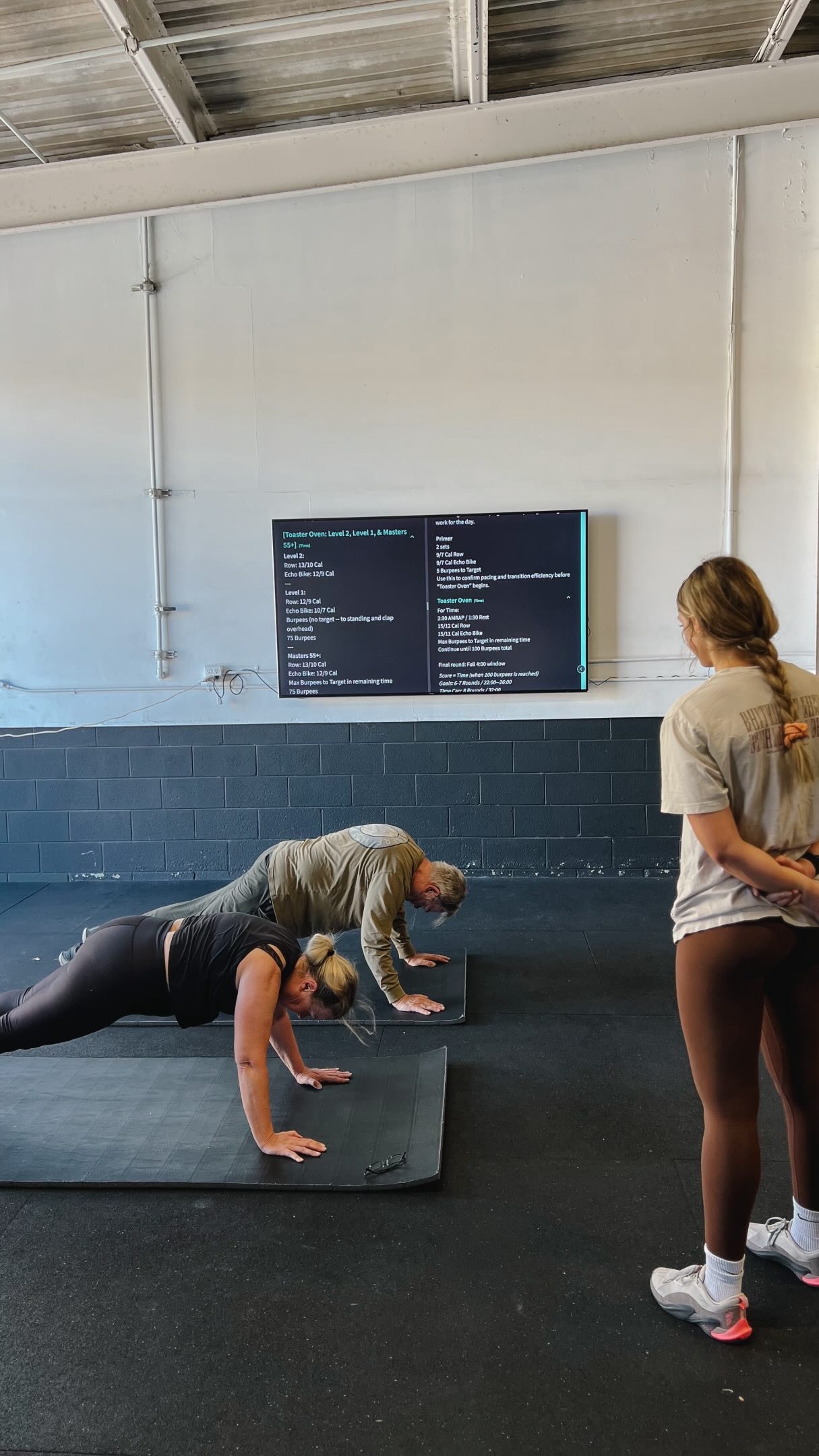
Plank
Learn the plank as a CrossFit beginner: forearm and high plank form, plank reaches and side planks, common faults and how to build a longer, stronger hold.
What the plank is
A plank is a hold where you support your body in a straight line from head to heels on your forearms or hands and your toes. It trains your trunk to stay stiff and resist sagging or twisting, a skill that carries into nearly every lift. Beginners start with short holds, often from the knees or with hands on a box, and add time and variations such as plank reaches as form stays solid.
Why it is in class
The plank is in CrossFit because a strong, stable trunk is what lets your arms and legs pass force safely. Squats, presses, push-ups, handstands and carries all rely on the same skill: holding your midsection still while weight or movement tries to bend it. The plank teaches that skill in its simplest form, with no equipment and no skill barrier. Variations such as plank reaches and side planks add the challenge of resisting rotation and side bending. In daily life, that shows up when you lift a heavy box, push a stroller up a hill, carry laundry up the stairs, or get down to the floor and back up without straining your back.
Points of performance
What a good rep looks like, from setup to finish.
Stack the support
For a forearm plank, place elbows directly under your shoulders with forearms parallel or hands lightly clasped. For a high plank, place hands under the shoulders with fingers spread. Press the floor away so the upper back stays full instead of sagging between the shoulder blades.
Straight line
Extend your legs behind you, feet about hip width, and lift into a line from head to heels. Neck neutral, eyes on the floor just in front of your hands. Hips neither piked up nor sagging. A mirror, a coach or a phone video shows the line quickly.
Squeeze everything
Tuck the pelvis slightly, squeeze the glutes, pull the ribs down toward the hips and brace as if someone were about to poke your stomach. Push your heels back. A well squeezed plank feels hard within seconds, and that is exactly the point.
Breathe while braced
Keep breathing in short, controlled breaths without letting the belly drop. Holding your breath makes a plank feel easier for a moment and harder soon after. Learning to breathe under a brace carries straight into heavier lifts later on.
Reaches and side planks
For plank reaches, lift one hand from a high or forearm plank and reach forward without letting the hips rock, then switch. Widen the feet to make it easier. For a side plank, stack on one forearm with the body in a straight line facing sideways.
Common beginner faults, and the fix
Sagging hips
What it looks likeThe lower back dips toward the floor, the belly hangs, and the athlete feels it in the low back.
The fixSqueeze the glutes and pull the ribs down. Shorten the hold or drop to the knees until you can keep the line.
Piked hips
What it looks likeThe hips rise high into an upside down V, taking weight off the trunk.
The fixLower the hips until shoulders, hips and heels line up. A coach may lay a dowel along your back to check.
Shoulders collapsing
What it looks likeThe chest sinks between the shoulder blades and the head droops toward the floor.
The fixPush the floor away through forearms or hands and keep your eyes just ahead of your hands.
Rocking on reaches
What it looks likeDuring plank reaches, the hips swing side to side each time a hand lifts.
The fixWiden the feet, slow down and squeeze harder. Reach only as far as you can without the hips moving.
Where you start, and where it goes
Every movement in class has a version that fits you today.
Start here
Short holds of 10 to 20 seconds on the knees or with hands on a box or bench, repeated a few times with rest.
Next step when: You can hold 30 seconds with a straight line and steady breathing for several sets.
Building
Full forearm or high plank holds on the toes for 20 to 40 seconds, plus short side planks from the knees.
Next step when: You can hold a full plank for around 45 seconds with no sag, and side planks on each side look clean.
Full movement
Planks, plank reaches and side planks as written in class, for time or reps, often inside a core section or warm-up.
Next step when: You meet the class hold times and reach without any hip rocking.
Beyond
Longer holds, plank reaches with narrow feet, weighted planks, plank walkouts and side planks with a leg lift.
Next step when: This rung keeps going: harder variations matter more than longer holds, and a clean minute beats a sloppy five.
Learning it in your first classes
In your first coached classes, the plank often shows up in the warm-up or at the end of a session. The coach will check your line from the side, then your shoulders and how you breathe. Expect it to feel harder than you remember, especially once you squeeze properly. Starting on your knees or with hands on a box is a strong choice, not a lesser one. Tell your coach about any back, shoulder or wrist history, or a recent pregnancy, and check with a doctor or physical therapist when it applies. Your coach can switch you to forearms if your wrists complain, or onto your hands if your elbows do.
What your first class at O-SEA CrossFit is like · How On-Ramp teaches the movements
Questions beginners ask
How long should a beginner hold a plank?
A beginner can start with plank holds of 10 to 30 seconds, repeated a few times with rest. The goal is a clean line and steady breathing for the whole hold, not a long time with sagging hips. Add a few seconds each week or move to harder variations. In a CrossFit class, a coach will set hold times that fit you.
Is a forearm plank or a high plank better?
Both are useful planks. A forearm plank usually feels harder on the trunk and easier on the wrists, while a high plank, on the hands, also works the shoulders and matches the top of a push-up. Beginners can train both. If your wrists or shoulders feel uncomfortable in one, your coach can steer you to the other.
What are plank reaches?
Plank reaches are a plank variation where you lift one hand and reach forward while the rest of the body stays still, then switch hands. Removing a point of support forces your trunk to resist twisting. Start with your feet wide and keep the reaches short. When your hips stay level, bring the feet closer to make each plank reach harder.
Will planks give me a flat stomach?
Planks build trunk strength and control, but no single exercise burns fat from one spot or guarantees a flat stomach. Body composition depends on overall training, food, sleep and more. The real value of the plank is a stronger, steadier midsection that supports lifting, running and daily life. Your coach can talk through your goals with you.
Related movements
Learn the plank with a coach beside you
Every class at O-SEA CrossFit is coached and every movement scales. Your first one is free.