
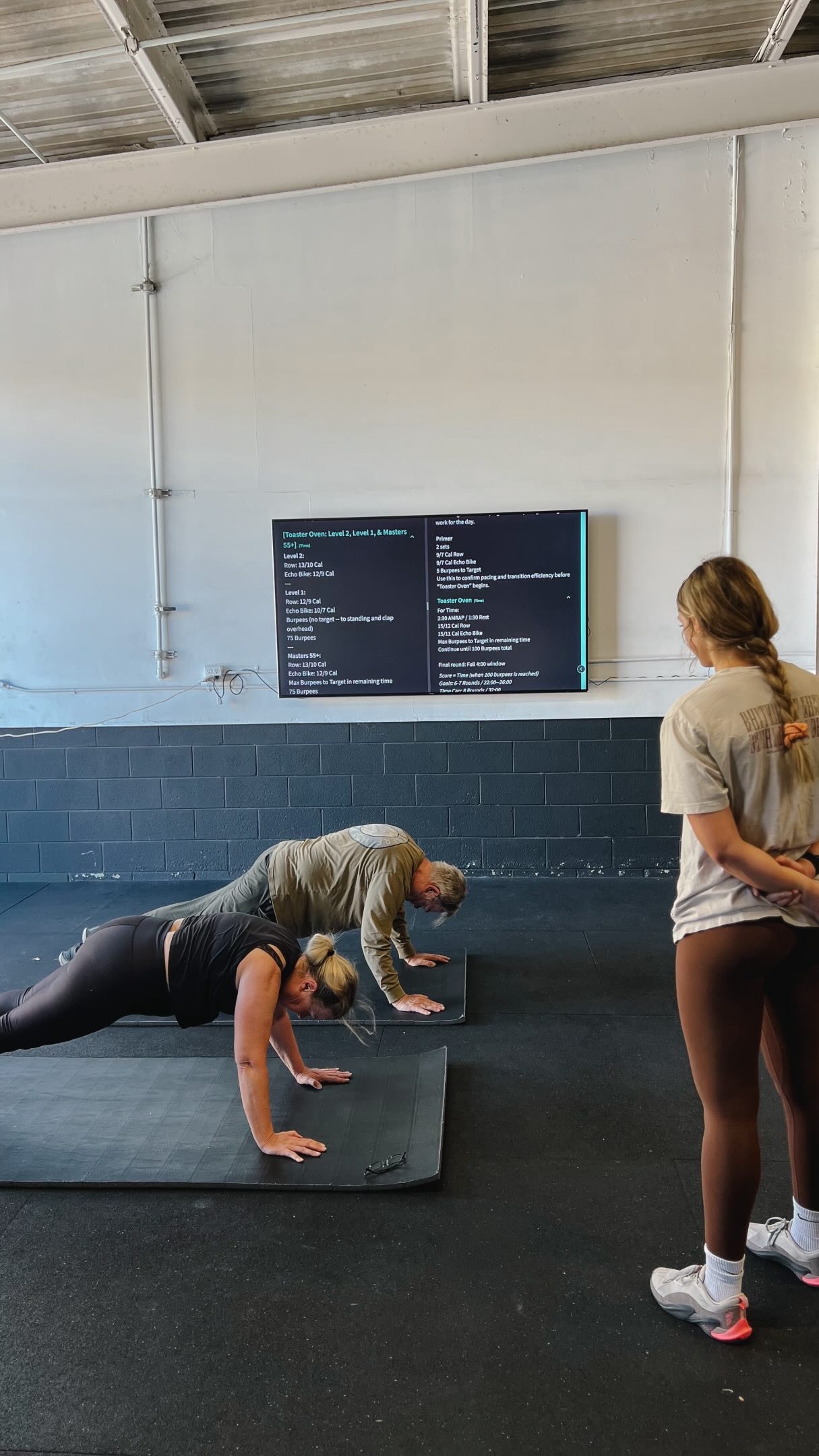
Push-up
Build a real push-up from scratch: hand position, a solid plank, chest to the floor, the faults beginners make, and the incline steps that get you there.
What the push-up is
A push-up is a bodyweight pressing movement where you hold a straight plank on your hands and toes, lower your chest to the floor and press back up to locked arms. It trains the chest, shoulders, triceps and the trunk muscles that keep the body rigid. Beginners start with the hands elevated on a box or bar and lower the incline over time.
Why it is in class
The push-up is one of the most honest strength tests there is: your body is the weight, and the floor tells you whether you went all the way down. CrossFit uses it because it builds pressing strength and a tight midline at the same time, with no equipment and almost no setup. It appears in warm-ups, in workouts and inside every burpee, so getting it right early pays off in many places. In everyday life the same strength helps you push yourself up off the floor after playing with kids or grandkids, shove a stuck window open, or catch yourself with steady arms if you stumble forward.
Points of performance
What a good rep looks like, from setup to finish.
Hands under shoulders
Place the hands slightly wider than shoulder width with the fingers spread and pointing forward. When you lower, the hands should end up roughly under the chest. Grip the floor with the fingertips to give the wrists a firm base rather than resting all your weight on the heel of the hand.
Plank first
Before any rep, lock in a plank on straight arms: legs together, glutes squeezed, stomach braced and head in line with the spine. This is the position you hold for the whole set. If the plank falls apart, the push-up has stopped doing its job.
Elbows back at an angle
As you lower, let the elbows travel back at roughly 45 degrees from your body, forming an arrow shape rather than a T. Flared elbows strain the front of the shoulder. Tucked a little, they let the chest and triceps share the work evenly.
Chest touches the floor
Lower the whole body as one unit until the chest makes contact with the floor or the target. Hips and chest arrive together. Many CrossFit workouts use a chest to the deck standard with arms locked at the top, so learn full depth from the start.
Press to lockout
Push the floor away until the elbows are fully straight and the shoulder blades spread slightly apart at the top. The body rises in one piece, without the chest coming up first. Take a breath at the top before lowering again.
Common beginner faults, and the fix
Worming
What it looks likeThe chest lifts first and the hips peel off the floor afterward, like a wave rolling down the body.
The fixSqueeze the glutes and stomach before the press, and use a higher incline until the whole body can rise at once.
Sagging hips
What it looks likeThe lower back arches and the hips drop toward the floor, especially late in a set.
The fixTuck the ribs, squeeze the glutes and shorten the set. Rest briefly rather than letting the back collapse.
Half range
What it looks likeThe athlete dips a few inches and presses back up without the chest getting near the floor.
The fixPlace a foam block under the chest as a target, or raise the hands on a box so full depth becomes possible.
Head dropping
What it looks likeThe chin pokes down toward the floor ahead of the chest, giving the look of depth without the real thing.
The fixLook at the floor a little ahead of your hands and keep the neck in line with the spine the whole time.
Where you start, and where it goes
Every movement in class has a version that fits you today.
Start here
Incline push-ups with the hands on a box, bench or barbell set in a rack, keeping a full plank and full range.
Next step when: When you can do sets of ten to fifteen at that height with the chest touching the target and no hip sag.
Building
Lower incline push-ups, moving the hands down step by step, plus slow lowering from the floor in a plank.
Next step when: When a low incline feels controlled and you can lower all the way to the floor slowly without the body breaking.
Full movement
Push-ups from the floor with the chest to the floor and arms locked out at the top.
Next step when: When you can string together sets of quality floor push-ups and keep form inside a workout, start adding variations.
Beyond
Hand release push-ups, deficit push-ups with the hands on plates, ring push-ups and weighted push-ups.
Next step when: Add these one at a time and keep the strict plank and full range that made the basic push-up honest.
Learning it in your first classes
Many adults have not done a push-up in years, and your first coached classes are where you find out where yours stands, without pressure. Your coach will likely ask for a few reps at an incline and watch how your body holds together, how deep you go and where your elbows travel. Expect them to raise or lower your hands until every rep can be full range. Let them know about any wrist, elbow or shoulder history before you start, since hand position and tools like parallettes or dumbbells change how the joints feel. Tell them, too, if your wrists ache during a set.
What your first class at O-SEA CrossFit is like · How On-Ramp teaches the movements
Questions beginners ask
Are knee push-ups a good way to start?
Knee push-ups can help, but many coaches prefer incline push-ups for beginners because the incline keeps the full plank from head to toe. That trains the same body position as a floor push-up. Your coach may use both. Whichever you use, keep full range so the push-up you build carries over to the real thing.
How many push-ups should a beginner be able to do?
There is no number a beginner should hit on the first day. What matters is that every push-up is full range with a solid plank. Plenty of adults start at a high incline, and that is a strong starting point. Track progress by how low the incline goes over the weeks and how many clean reps you can string together.
My wrists hurt during push-ups. What can I do?
Wrist discomfort during push-ups is common for adults returning to training. Spreading the fingers, gripping the floor and warming up the wrists can help, and holding dumbbells or parallettes keeps the wrist straight. If the pain is sharp or lasts after class, tell your coach and check with a doctor or physical therapist before continuing.
What is a hand release push-up?
A hand release push-up is a version where you lower all the way to the floor, lift your hands briefly off the ground, then place them back and press up. It enforces full depth on every rep, which is why it shows up in workouts. Beginners can scale a hand release push-up with an incline.
Should my elbows flare out or stay tucked?
In a push-up, the elbows should travel back at roughly a 45 degree angle from the body, between flared wide and pinned tight. That position shares the work across the chest, shoulders and triceps and is easier on the front of the shoulder. Your coach can watch a few reps and fine tune it for your build.
Related movements
Learn the push-up with a coach beside you
Every class at O-SEA CrossFit is coached and every movement scales. Your first one is free.