
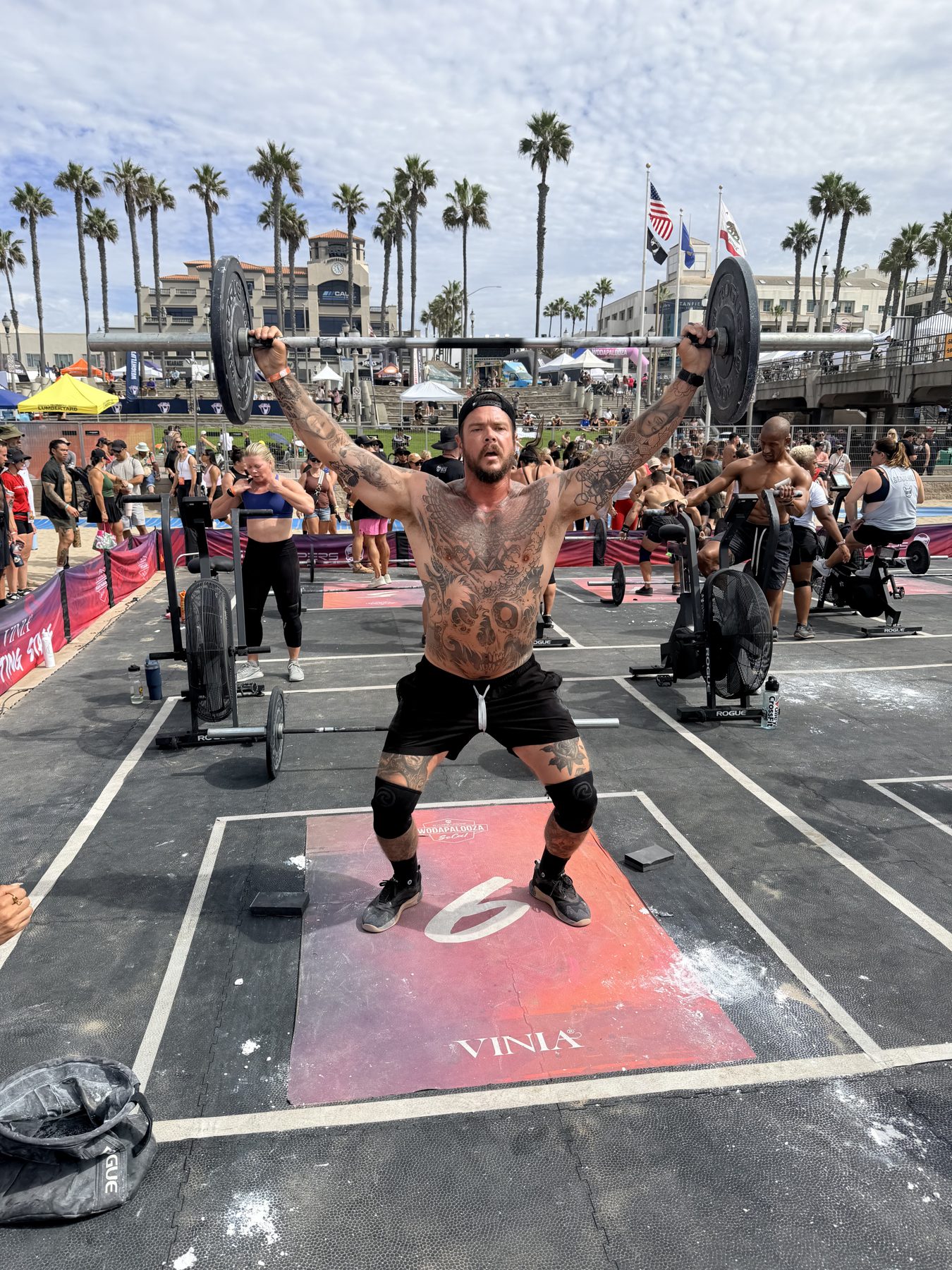
Power snatch
A beginner guide to the power snatch: wide grip, the pull, the punch overhead, common faults, and scaling steps from a PVC pipe to a loaded barbell in class.
What the power snatch is
The power snatch is an Olympic weightlifting movement that takes a barbell from the floor to locked arms overhead in one fast motion, using a wide grip and catching the bar in a partial squat. It trains explosive power, speed, coordination and overhead stability. Beginners learn it in steps with a PVC pipe, starting from the hips.
Why it is in class
The power snatch is one of the fastest lifts in the gym, and it is in CrossFit because it asks the whole body to work together at speed: legs and hips produce the power, the back transmits it and the shoulders receive it overhead. It builds coordination and confidence under a bar in a way few other movements can. The skill carries over to athletic movement of every kind: jumping, throwing and changing direction all use the same rapid hip extension. It also builds overhead strength and mobility that make simple tasks easier, like lifting something light from the floor and stowing it high in one motion. It rewards patience, which makes it a satisfying long term skill to practice.
Points of performance
What a good rep looks like, from setup to finish.
Find your wide grip
Hold the bar with a grip wide enough that, standing tall, the bar sits in the crease of the hips. A simple way to find it is to hold your arms straight out sideways and measure fist to opposite shoulder. Use a hook grip once you are comfortable.
Set up and push the floor
Bar over the middle of the foot, hips a bit lower than in a clean because of the wide grip, back flat, chest up and arms long. Push the floor away with the legs and keep the back angle while the bar rises past the knees, close to the shins.
Jump with the bar in the hip crease
As the bar reaches the upper thigh, drive the hips forward and jump hard so the bar contacts the hip crease. Arms stay long and loose. The power comes from the legs and hips, not from pulling with the hands.
Pull under and punch up
After the jump, pull the elbows high and outward to guide the bar up close to the body, then turn the hands over and punch into the bar as you drop under it. The feet move slightly wider and land flat.
Catch locked and stand up
Receive the bar overhead with arms straight, slightly behind the head, in a quarter squat with an upright chest. Hold it still, then stand up fully. A rep counts with hips, knees and elbows locked and the bar steady overhead.
Common beginner faults, and the fix
Bar looping forward
What it looks likeThe bar swings in an arc away from the body after the hip contact and the lifter jumps forward to save it.
The fixKeep the bar close and brush it up the body with high elbows. Snatch high pulls with an empty bar teach the path.
Pressing out overhead
What it looks likeThe bar arrives with bent arms and the lifter finishes by pressing it up.
The fixPunch into the bar as the feet land. Lighten the weight and practice drop snatches or snatch balance drills with a pipe.
Early arm pull
What it looks likeThe elbows bend below the hips, so the bar never gets the drive from the legs.
The fixKeep the arms long like ropes until the hips finish. Practice from the hip with no arm bend until the jump is automatic.
Unstable overhead catch
What it looks likeShoulders relaxed, bar wobbling, elbows soft or the head poking forward.
The fixPush up into the bar and squeeze the shoulder blades. Overhead holds and overhead squats with a pipe build the position.
Where you start, and where it goes
Every movement in class has a version that fits you today.
Start here
PVC pipe snatch progression: overhead squat position, muscle snatch, then power snatch from the hip, practiced slowly.
Next step when: With the pipe you can jump and punch into a locked overhead catch with flat feet and an upright chest.
Building
Hang power snatch with an empty training bar or a single dumbbell, starting at the hip and then above the knee.
Next step when: The bar stays close, your arms stay long until the jump is done, and every catch is locked.
Full movement
Barbell power snatch from the floor, adding weight slowly in sets of 2 or 3.
Next step when: Your pull from the floor keeps a flat back and your catch at moderate weights matches your empty bar reps.
Beyond
The full squat snatch, heavier power snatches and snatches inside workouts.
Next step when: Your coach programs it and your overhead squat position is strong enough to receive the bar low.
Learning it in your first classes
The power snatch usually takes the longest of any lift for a beginner to feel comfortable with, and that is normal. Your first coached sessions will use a PVC pipe and a lot of short drills: finding your grip, holding the bar overhead, jumping from the hip and punching under. Your coach watches whether the bar stays close, whether your arms bend too early, and whether your catch is locked and steady overhead. You may stay with a pipe or empty bar for some weeks, and that is time well spent. Tell the coach about any shoulder, wrist, back or knee history, and say so if reaching overhead with a wide grip is uncomfortable. Stop if something feels sharp, and check with a doctor or physical therapist if it continues.
What your first class at O-SEA CrossFit is like · How On-Ramp teaches the movements
Questions beginners ask
Is the power snatch the hardest lift in CrossFit?
The power snatch is often called the most technical lift in CrossFit because the bar travels the farthest, fastest, and must be caught overhead with a wide grip. That does not put it out of reach for beginners. With a PVC pipe and patient coaching, most people learn a solid light power snatch over a period of weeks.
What is the difference between a power snatch and a squat snatch?
In a power snatch you catch the bar overhead in a partial squat with the hips above the knees. In a squat snatch, often just called a snatch, you catch it in a full overhead squat and then stand. The squat snatch allows heavier weights but needs more mobility and more practice.
How wide should my grip be for a power snatch?
The power snatch grip should be wide enough that the bar sits in the crease of your hips when you stand tall with straight arms. For most people that puts the hands well outside the shoulders. Your coach will help you find a width that keeps the bar close and lets you lock out comfortably overhead.
Can I learn the power snatch with a dumbbell?
Yes. A single arm dumbbell power snatch is common in CrossFit and is a friendly way to learn the jump and the punch overhead. It uses the same hip drive, with one arm. Many beginners do dumbbell snatches in workouts while they build their barbell technique in separate skill practice.
Why do I keep catching my power snatch with bent arms?
Catching a power snatch with bent arms usually means the weight is too heavy, the jump was short, or the punch under came late. Drop back to an empty bar or pipe, finish the hip drive fully, and drive your arms straight as your feet land. Overhead holds and pipe drills build the reflex.
Related movements
Learn the power snatch with a coach beside you
Every class at O-SEA CrossFit is coached and every movement scales. Your first one is free.