
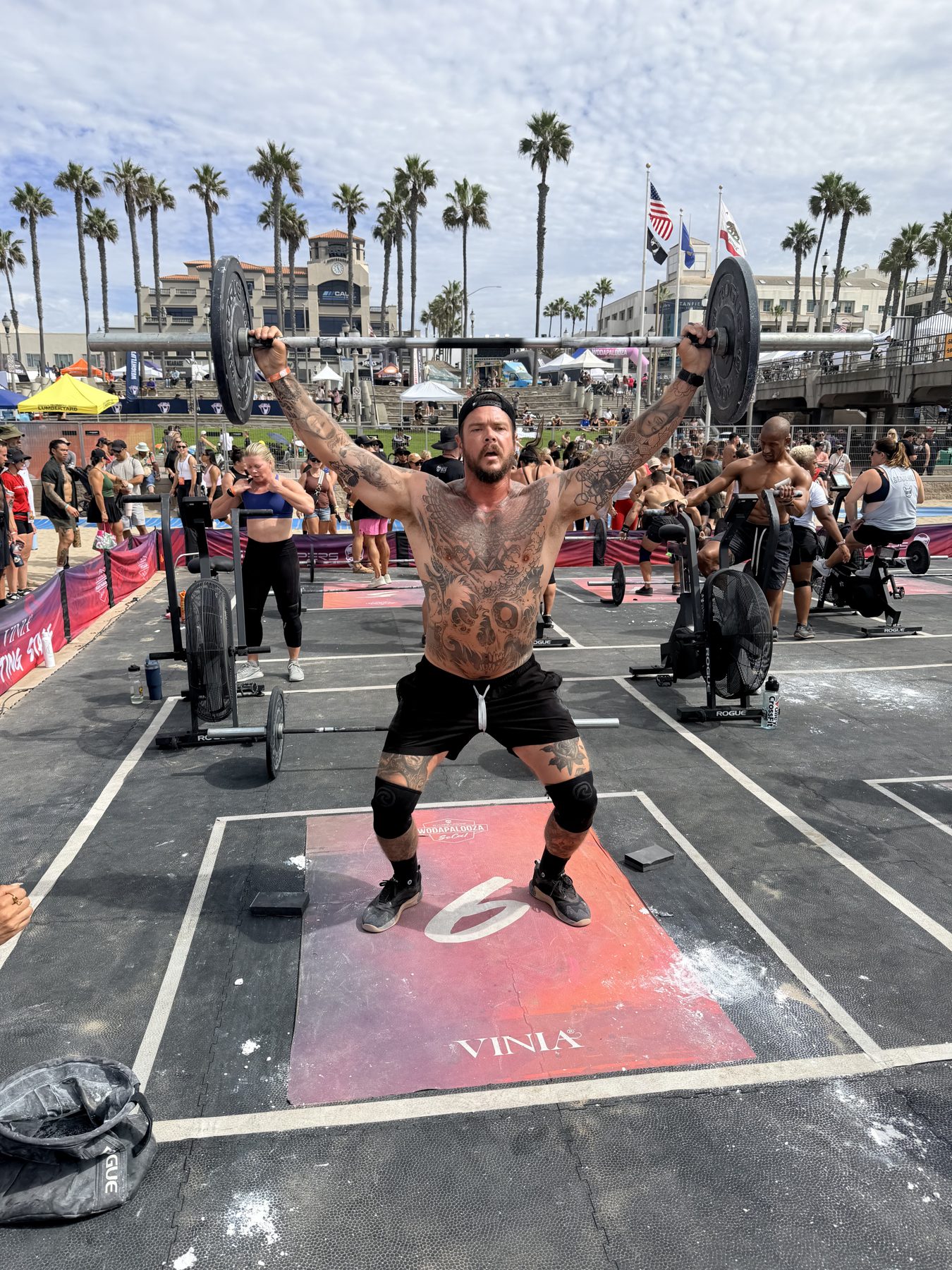
Overhead squat
The overhead squat for beginners: grip width, lockout, bracing, why the bar drifts forward, and four scaling steps from PVC pipe to a loaded barbell.
What the overhead squat is
The overhead squat is a full squat performed while holding a barbell or PVC pipe locked out overhead with a wide grip. It trains leg strength, shoulder stability, trunk control and the mobility to stay upright, and it is the receiving position for the snatch. A beginner starts with a PVC pipe, learning to hold the overhead position steady before squatting under it.
Why it is in class
CrossFit uses the overhead squat because it shows almost everything about how your body moves at once. Tight ankles, stiff hips, a weak midline or unstable shoulders all appear the moment you try to squat with your arms locked overhead. Practicing it builds the stability to hold something above your head while your lower body moves, which is the backbone of the snatch. Outside the gym, the same control helps when you reach up to place a heavy box on a high shelf or steady a load above your head while your footing shifts. It is a demanding movement, and that is the point: it rewards patient practice with a pipe long before the bar gets heavy.
Points of performance
What a good rep looks like, from setup to finish.
Find your grip
Hold the pipe or bar with a wide snatch grip. A common starting point is the width where the bar sits near your hip crease when you stand with straight arms. Your coach can help you find the width that lets your shoulders lock out comfortably.
Lock out overhead
Press or push the bar overhead and lock your elbows. Push up into the bar actively, as if trying to shrug it toward the ceiling, and turn your armpits forward. The bar should sit over the back of your neck, stacked over the middle of your foot.
Brace the trunk
Breathe in and tighten your midsection before moving. The overhead squat punishes a soft trunk, because any wobble in the middle sends the bar forward or back. Keep your ribs down, not flared up toward the bar.
Sit straight down
Lower your hips straight down between your heels while keeping the bar over the middle of your foot. Your torso stays upright and your arms stay locked. Go only as deep as you can hold the bar steady and your heels down.
Stand with the bar steady
Drive up through your whole foot and keep pushing into the bar as you rise. Finish standing tall with the bar still locked out. Lower it to your back or the front rack with control between reps, never by letting it crash down.
Common beginner faults, and the fix
Bar drifts forward
What it looks likeAs the lifter descends, the bar moves out in front of the face and the chest drops to chase it.
The fixPush the bar back so it sits over the back of the neck and squat with the pipe. Reduce the depth until you can keep it stacked. Ankle and upper back mobility often limit this, and your coach will suggest drills.
Elbows soften
What it looks likeThe arms bend and the bar sinks toward the head, usually at the bottom of the squat.
The fixCue lock and push up. Think about pulling the bar apart as if trying to stretch it. Overhead holds and pressing work build the strength to stay locked out.
Heels lift or knees cave
What it looks likeThe lifter rocks forward onto the toes or the knees slip inward to find depth.
The fixUse a shorter range for now, or squat to a box, while ankles and hips open up. Keep weight across the whole foot and knees tracking over the toes.
Ribs flare
What it looks likeThe lower back arches hard and the chest pops upward under the bar, especially early in the descent.
The fixExhale slightly and pull the ribs down before you start, then brace. Lighter work with a pipe and a slow tempo lets you feel and correct the position.
Where you start, and where it goes
Every movement in class has a version that fits you today.
Start here
PVC overhead squats to a comfortable depth, or squats with the pipe held straight out in front of you.
Next step when: You can hold the pipe locked out for 30 seconds and squat a few inches without it moving forward.
Building
PVC or empty barbell overhead squats to a box set at your current depth, plus overhead holds and snatch balance drills with a light bar.
Next step when: You reach full depth with a pipe, heels down, bar stacked and arms locked for several reps in a row.
Full movement
Barbell overhead squats with light load to full depth, used in strength sets or short workouts.
Next step when: Load climbs steadily and the bar still stays over the middle of the foot through every rep.
Beyond
Heavier overhead squats, overhead squats inside conditioning workouts, and using the position to receive the snatch.
Next step when: Your coach will connect the overhead squat to the full snatch when the position is stable under load.
Overhead squat in real classes
3 videos from the gym floor in San Clemente, shared by our coaches and members.
Overhead squat, filmed at O-SEA CrossFit
Watch it, then read the steps above. Every movement we coach is on our channel.
Learning it in your first classes
Expect the overhead squat to feel awkward in your first classes, and almost everyone starts with a PVC pipe and partial depth. Your coach will check your grip width, watch whether the bar stays over your midfoot, and look at your ankles and shoulders to see what is limiting you. They may give you a goblet squat or front squat in a workout while you build the position. Tell your coach about any shoulder history, including old dislocations or surgeries, and stop if anything pinches overhead. A doctor or physical therapist can advise you on a shoulder issue, and your coach will adjust the work around it.
What your first class at O-SEA CrossFit is like · How On-Ramp teaches the movements
Questions beginners ask
Why is the overhead squat so hard?
The overhead squat is hard because it asks your ankles, hips, trunk and shoulders to work together under load all at once. Any limitation in one area shows up as the bar drifting or the torso tipping. Most beginners spend weeks or months with a PVC pipe before adding weight, and that patience is part of learning it.
How wide should my grip be for the overhead squat?
Overhead squat grip is usually wide, similar to a snatch grip. A practical starting point is where the bar sits around the hip crease when you hold it with straight arms. A wider grip often makes the lockout easier. Your coach can adjust it based on your arm length and shoulder comfort.
What should I do if I cannot overhead squat to full depth?
If you cannot overhead squat to full depth yet, squat only as deep as you can keep the bar stacked and your heels down, or squat to a box. In workouts, your coach will often substitute a front squat or goblet squat while you build mobility and control. Full depth comes from steady practice.
Do I need to overhead squat to learn the snatch?
The overhead squat is the receiving position of a full snatch, so it matters for learning that lift. Many beginners learn the power snatch first, catching the bar higher, while they keep practicing the overhead squat with a pipe. Your coach will sequence the two so you build both with good positions.
Related movements
Learn the overhead squat with a coach beside you
Every class at O-SEA CrossFit is coached and every movement scales. Your first one is free.