
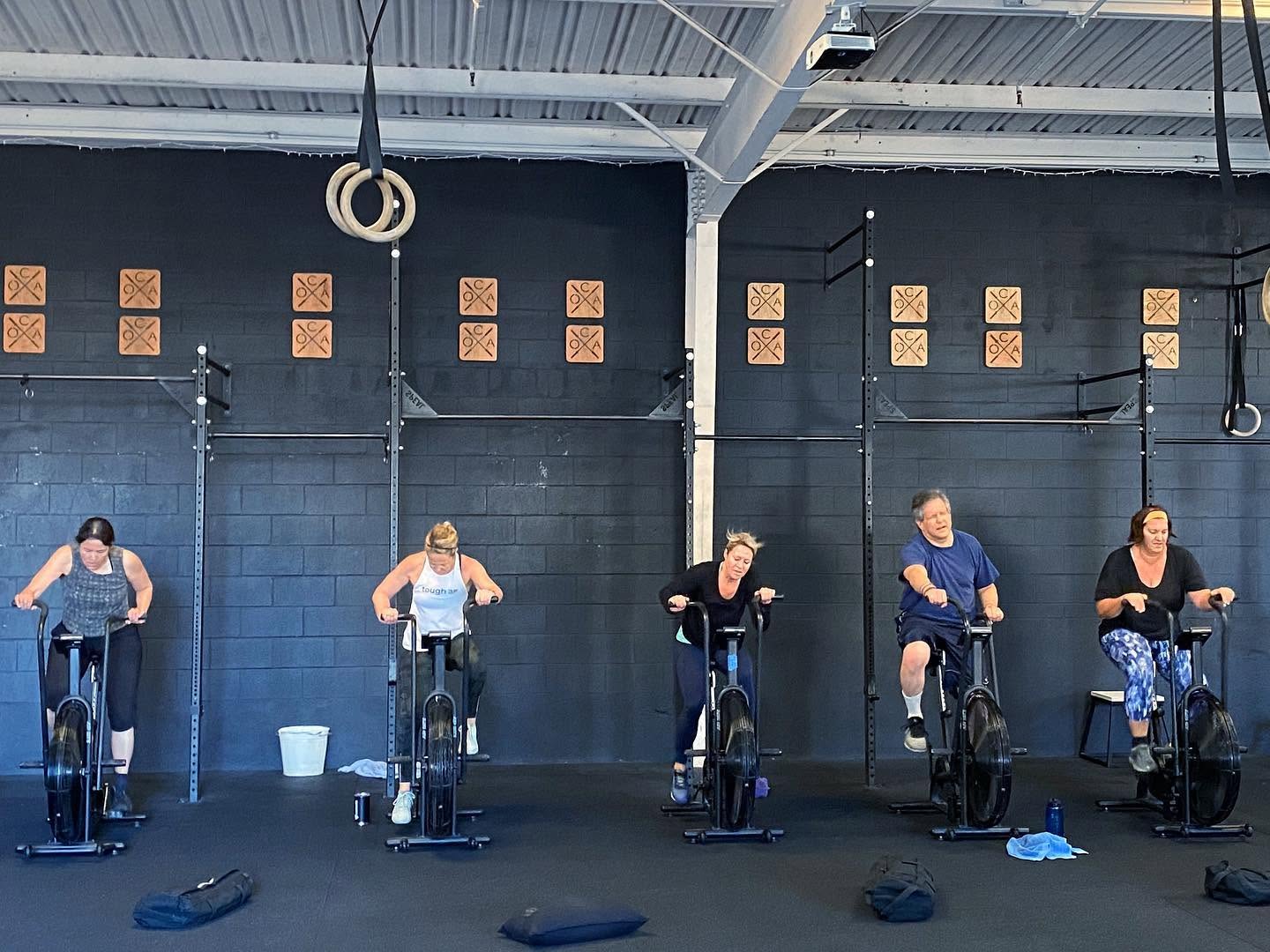
Air bike
How to ride the air bike as a beginner in CrossFit: seat setup, pushing and pulling the handles, pacing your calories and scaling your first workouts.
What the air bike is
The air bike is a stationary bike with a large fan wheel and moving handles, so your arms push and pull while your legs pedal. The harder you work, the more the fan resists, which makes it a conditioning tool that fits any fitness level. Beginners start with a correct seat setup and steady, easy efforts before trying sprints.
Why it is in class
The air bike is in CrossFit because it delivers hard conditioning with almost no skill barrier and no impact. Anyone can sit down and work, and the fan matches exactly what you put in, so a returning athlete and a seasoned one get the same challenge at their own level. Because the arms and legs work together, it raises your heart rate quickly and teaches you to keep going when breathing gets heavy. That capacity carries into everyday life: climbing several flights of stairs without stopping, riding bikes with family, shoveling, or recovering faster after a burst of effort like chasing a bus. It is also a useful option on days when running or jumping does not suit you.
Points of performance
What a good rep looks like, from setup to finish.
Seat height
Set the seat so your knee keeps a slight bend when the pedal is at its lowest point. Too low and your knees crowd the handles and tire fast. Too high and your hips rock side to side. Adjust it forward or back so you reach the handles without leaning far.
Tall posture
Sit up with your chest proud and your weight centered on the seat, not slumped over the console. A tall trunk lets you breathe fully and connects arm and leg effort. Grip the handles firmly enough to control them, with shoulders relaxed away from your ears.
Push and pull
Your arms both push and pull. As one handle moves away, the other comes back toward you, so think of rowing with one arm while pressing with the other. Coordinating your hands with your feet adds power and spreads the work across more muscle.
Drive through the whole foot
Press the pedal with the ball and middle of your foot through the full circle. Smooth, even pressure beats stomping. Picture pushing down and slightly forward at the top of each stroke so the fan never coasts between pedal strokes.
Pace before you push
Pick an effort you can hold, watch the calories or watts on the monitor, and settle there for the first part of a piece. The fan punishes a fast start. Save the all out push for the final stretch, once you know you can finish.
Common beginner faults, and the fix
Sprinting the opening
What it looks likeThe first fifteen seconds are a full sprint, calories pile up, then the pace collapses and the rest of the piece is a crawl.
The fixStart at a pace that feels almost too easy, hold it, and build. An even effort usually reaches the target calories sooner.
Arms along for the ride
What it looks likeHands rest on the handles while the legs do all the pedaling, and the handles drift loosely back and forth.
The fixActively push and pull the handles in rhythm with the pedals. Your coach may cue you to pull a handle back as the same side leg pushes down.
Rocking hips
What it looks likeThe hips sway side to side and the body bounces on the seat with each pedal stroke.
The fixLower the seat a notch if needed and brace your midsection lightly. Smooth circles and a quiet upper body put more effort into the fan.
Skipping the setup
What it looks likeKnees bump the handles, or the legs lock straight at the bottom of each stroke.
The fixTake a minute to set seat height before every workout. Your coach can help you find the setting for your height so you can reuse it.
Where you start, and where it goes
Every movement in class has a version that fits you today.
Start here
Easy steady riding for a few minutes, then short pieces of 10 to 15 seconds at a moderate push with long, easy recovery between them.
Next step when: You can ride three to five minutes steadily and get your breathing back within a minute after a short push.
Building
Longer intervals, such as 30 seconds harder and 30 seconds easy, or a set number of calories at a pace you can repeat.
Next step when: You can repeat the same calorie count over several rounds without the last ones falling off sharply.
Full movement
The air bike as written in class: calorie targets mixed with other movements, or timed pieces at a pace you choose and hold.
Next step when: You can pace a full class workout on the bike and still move well on the next movement.
Beyond
Hard sprints with full recovery, longer threshold efforts and calorie targets with a planned pace per minute.
Next step when: This rung keeps going: record your calories for a set time and try to beat your own number on a later day.
Air bike in real classes
2 videos from the gym floor in San Clemente, shared by our coaches and members.
Learning it in your first classes
Your first air bike session in a coached class usually starts with the coach helping you set the seat and showing you the monitor. You will ride easy to feel the fan respond, then try a few short pushes. Expect the coach to watch your seat height, your posture and whether your arms are helping. The bike can feel surprisingly hard, and that is normal: the fan matches your effort. Tell the coach about any knee, hip or back history, or if you feel lightheaded during hard efforts, so they can adjust the work or give you an alternative. Easy days on the bike count as real training.
What your first class at O-SEA CrossFit is like · How On-Ramp teaches the movements
Questions beginners ask
Why is the air bike so hard?
The air bike feels hard because the fan creates resistance that rises with your effort. Pedal harder and it pushes back harder, so it never gets easy at speed. Your arms and legs also work together, which raises your heart rate quickly. For a beginner that is useful: you control the intensity completely by how hard you choose to push.
How many calories should a beginner aim for on the air bike?
There is no single right calorie number on the air bike for a beginner. In a coached class, your coach will often scale a calorie target to your size and experience. A better goal is a pace you can hold for the full piece. Note how many calories you get in a minute at that pace and use it as your baseline.
Is the air bike good if I have bad knees?
The air bike is low impact, which is why coaches often offer it when running or jumping does not suit someone. Whether it suits your knees is a question for your doctor or physical therapist. Tell your coach about any knee history, and they can adjust seat height and effort, or swap in a different option if pedaling causes discomfort.
Should I use my arms on the air bike?
Yes, using your arms on the air bike spreads the work across more muscle and usually raises your output. Push one handle away while pulling the other back, in rhythm with your legs. Some workouts ask for legs only, but in most cases the arms are part of the movement. When your legs tire first, a stronger arm effort helps you hold pace.
Related movements
Learn the air bike with a coach beside you
Every class at O-SEA CrossFit is coached and every movement scales. Your first one is free.