
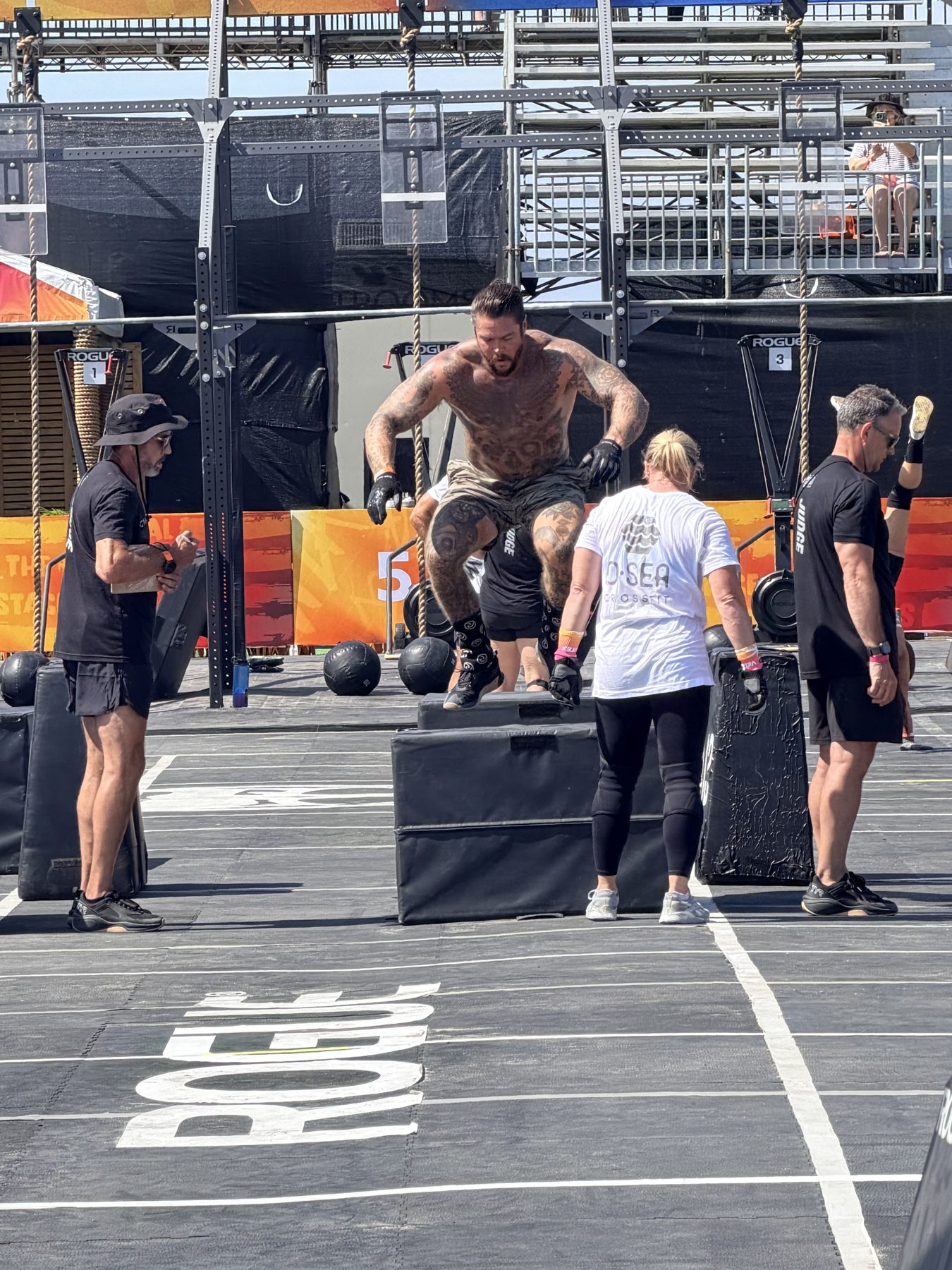
Box jump
Box jumps for beginners: start with step-ups, learn a soft two-foot landing, avoid common faults and build to jumping onto the box in a CrossFit class.
What the box jump is
A box jump is a two-foot jump from the floor onto a sturdy box, finished by standing tall on top with hips and knees fully open. It trains leg power, coordination and landing control. Beginners start with step-ups onto a low box, then small jumps onto a low height, before raising the box.
Why it is in class
Box jumps are in CrossFit because they train the ability to produce force fast and absorb it with control, two things most adults stop practicing after childhood. The jump teaches hips, knees and ankles to extend together, the same snap used in a clean or a push press. The landing teaches control, which matters as much as the power. Step-ups, the scaled version, build single-leg strength and balance. In daily life, that carries over to climbing stairs two at a time, stepping up onto a high curb or a truck bed, getting up from the floor, and catching yourself when you stumble. Confidence on a box often turns into confidence on uneven ground.
Points of performance
What a good rep looks like, from setup to finish.
Stand close
Stand about a foot from the box with your feet roughly hip width apart. Too far and you have to leap forward. Too close and your knees can clip the edge. Look at the top of the box, the spot where you want to land, not at the floor in front of it.
Load and swing
Hinge your hips back, bend your knees and swing your arms behind you, like the start of a standing long jump. This loads the legs. Then swing the arms forward and up as you drive hard through your feet. A strong arm swing adds real height to the jump.
Land soft
Land with both feet flat on the box at the same time, knees bent and tracking over your toes, hips back. Aim for a quiet landing in a partial squat. A loud slap or a knee that caves inward is your signal to slow down and lower the box.
Stand tall on top
Finish each rep by standing all the way up on the box with hips and knees fully open. In a standard CrossFit workout, this full standing finish is what counts the rep. Take a breath on top if you need it before you come down.
Step down
Step down one foot at a time instead of jumping down backward, especially as a beginner or when tired. Stepping down eases the load on the Achilles and knees and gives you a moment to reset. Turn to face the box and set up again for the next rep.
Common beginner faults, and the fix
Box too high too soon
What it looks likeThe athlete barely clears the edge and lands in a deep squat, toes hanging off the front of the box.
The fixChoose a height you can land on in a partial squat with both feet fully on top. Height comes later; clean landings come first.
Knees caving in
What it looks likeOn takeoff or landing, the knees collapse toward each other.
The fixCue knees out over the toes and lower the box. Practice jump and stick drills on the floor to rehearse a stable landing.
Rebounding off the floor
What it looks likeThe athlete jumps down backward and immediately bounces up again, moving fast but loose.
The fixStep down on every rep while learning. Rebounding is an advanced choice, and many coaches never ask beginners to use it.
Hesitating at the box
What it looks likeThe athlete stares at the edge, swings the arms again and again, and never commits to the jump.
The fixLower the box or switch to a soft foam box, and take one confident jump. Fear fades with repetitions at a height that feels sure.
Where you start, and where it goes
Every movement in class has a version that fits you today.
Start here
Step-ups onto a low box, one foot then the other, standing tall at the top and stepping down with control. Hold a wall or rig if balance is new.
Next step when: You can do 10 step-ups on each leg with steady balance, no knee caving and no push off the trailing foot.
Building
Weighted or higher step-ups, plus small two-foot jumps onto a low box or a stack of plates, stepping down every rep.
Next step when: You land jumps quietly with feet flat and knees tracking, and the low height feels easy.
Full movement
Box jumps at a height chosen with your coach, stepping down each rep, as written in the class workout.
Next step when: You can complete a full set at that height in a workout without catching a toe or landing deep.
Beyond
Higher boxes, box jump overs and, when a coach agrees, efficient rebounding for experienced athletes.
Next step when: This rung keeps going: raise height and speed only while landings stay quiet and controlled.
Learning it in your first classes
In your first coached classes, the coach will likely start you on step-ups or a low foam box. You will practice the arm swing, a short jump and a soft landing before any real height is involved. Expect the coach to watch your knees, your foot placement on top and whether you stand all the way up. Tell your coach about any knee, ankle, Achilles or back history, and about any balance concerns, so they can keep you on step-ups for as long as makes sense. Check with a doctor or physical therapist if a past injury makes you unsure about jumping. Missing a box once is common; most people laugh and lower it.
What your first class at O-SEA CrossFit is like · How On-Ramp teaches the movements
Questions beginners ask
What box height should a beginner use for box jumps?
A beginner should use a box jump height they can land on with both feet fully on top and knees in a partial squat. For many people that is lower than the heights listed in workouts. In CrossFit, the coach will help you pick a height or start you on step-ups. Raise the box only once landings at the current height are quiet and steady.
Are step-ups as good as box jumps?
Step-ups and box jumps train different things. Step-ups build single-leg strength and balance at a slower speed, while box jumps train explosive power and landing control. For beginners, step-ups are often the smarter choice and a full workout on their own. Many experienced athletes still use weighted step-ups. Your coach will choose the version that fits your goals and history.
Why do coaches say to step down from the box?
Coaches ask beginners to step down from the box because jumping down backward, especially when tired, puts a sudden load on the Achilles and knees and makes missteps more likely. Stepping down also gives you a moment to reset each box jump. It costs a few seconds and keeps the movement controlled. Many athletes step down for their whole training life.
What if I am afraid of hitting my shins on a box jump?
Fear of hitting your shins on a box jump is common and reasonable. Use a soft foam box, lower the height and stand a little closer. Practice step-ups until you feel confident, then small jumps where clearing the edge is easy. Commit fully to each jump, because half-hearted jumps are the ones that catch. Your coach will set a height that feels sure.
Related movements
Learn the box jump with a coach beside you
Every class at O-SEA CrossFit is coached and every movement scales. Your first one is free.