
What your first CrossFit class is actually like
An honest walkthrough of a first CrossFit class in San Clemente: what happens, what is scaled, what nobody tells you, and who it does not suit.
Most people who are curious about CrossFit do not stop because they tried it and disliked it. They stop because they cannot picture the first hour, and an hour you cannot picture is easy to keep postponing.
So here is the hour.
You arrive early and somebody talks to you
You get there about ten minutes before the session. Somebody asks your name, what you have done before, and whether anything currently hurts. That last question is not small talk. The answer changes what you are asked to do that day, and a coach who does not ask it is not paying attention.
You are not left to work out where to stand.
The workout is written on the board, and then it is changed for you
Every session has one workout written up for everybody. What is written is the hardest version. Almost nobody in the room does exactly that, and that is the part beginners misread: the board is a starting point, not a standard you are being measured against.
Scaling is the word for changing it to fit you. A lighter bar. Fewer rounds. A box step instead of a jump. A ring row instead of a pull-up. It is not a beginner version of the class, it is how the class works for everyone in it.
The warm-up is longer than you expect
Ten to fifteen minutes of it, and for a first session it doubles as an assessment. The coach is watching how your hips and shoulders move so they can decide what to change before you pick anything heavy up.
The hard part is shorter than you expect
The workout itself is often eight to fifteen minutes. It is genuinely hard for that stretch and then it is over. People new to it usually expect an hour of suffering and find the opposite: a long, chatty, technical build-up and one short honest effort.
Nobody is watching you
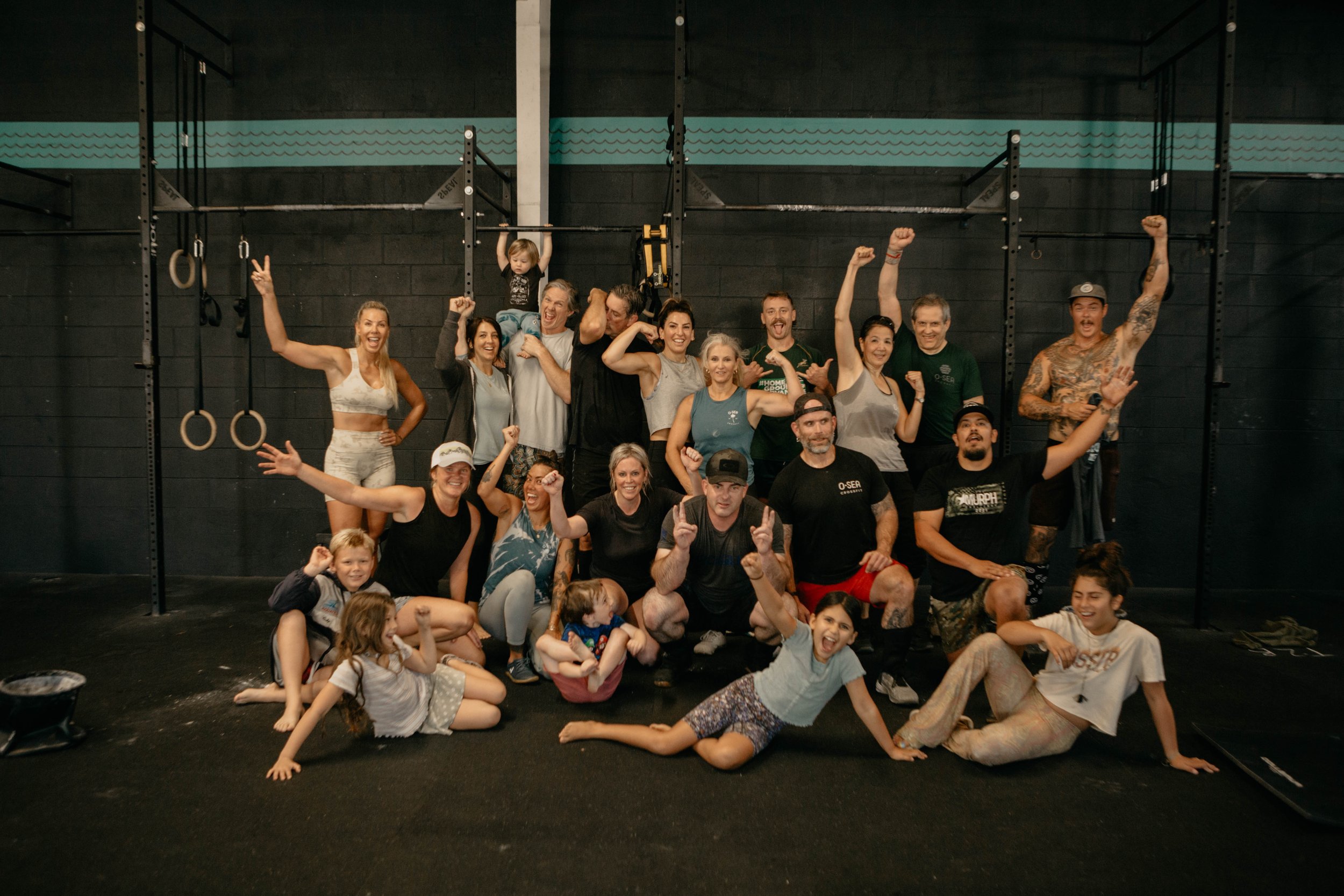
This is the one nobody believes until they see it. The fear is being the worst person in the room. The reality is that everyone is mid-effort and counting their own reps, and the people who finish first generally walk back to encourage whoever is still going. That is not a culture we invented. It is the ordinary behavior of a room that has been doing this a while.
What you will feel the next day
Sore, in places you did not plan on. That is normal and it settles after the first couple of weeks. Sharp pain in a joint during a movement is not normal and is a reason to stop and say so at the time, not afterward.
Where this does not suit somebody
It is worth saying plainly, because a guide that only sells is not a guide.
- If you want to train alone with headphones on, a group class is the wrong shape and one-to-one coaching is the right one.
- If you are working around an injury or a recent operation, start with your clinician, then come and talk to a coach about what they have cleared.
- If your schedule only allows the same 30-minute window at unpredictable times, a class timetable will frustrate you.
- If you want a specific competitive outcome by a specific date, say so first: that is a program, not a drop-in.
What to bring
Shoes you can move in, a water bottle to fill up at our premium water station, and something you do not mind sweating in. Nothing else. Specialist shoes and equipment are a thing people buy later, if at all, and never before a first session.
The honest summary
Starting CrossFit as a beginner is mostly an exercise in getting through the door once. The workout is scalable, the room is friendlier than the internet suggests, and the first session is designed to find out what you can do rather than to prove what you cannot.
Come and watch one first if that is easier. Standing at the side of a session answers more questions than any page can.
Common questions
Do I need to be fit before I start?
No. The workout is scaled to what you can do on the day, which is the entire point of scaling.
What if I cannot do a pull-up?
Most people in any given class cannot. There is a substitute for every movement and you will be given one.
Can I watch a class before joining?
Yes. Come and stand at the side of a session. It answers more than a website can.
How long is a session?
About an hour, including the warm-up and the coaching. The hard part in the middle is usually much shorter than people expect.
Come and see for yourself
A conversation costs nothing and answers more than any page.